
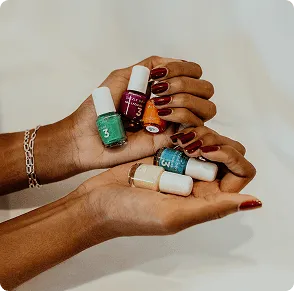
Every nail service on the menu claims to be the "healthy" choice these days — gel, dip, acrylic, hard gel, and newer air-dry lacquers all get marketed that way. So which one actually is? The honest answer is that health isn't a single line item you can read off a bottle. It comes down to three things working together: what's in the formula, how it's applied, and — the part most guides skip — how it comes off. Here's how the major manicure options compare, service by service.
What "healthiest" really means for a manicure
A formula free of harsh solvents is a great start, but it's only one piece. The application matters too — how much filing and buffing your natural nail takes before product goes on. And removal matters most of all: a service that's gentle to put on can still damage your nail plate if it's stripped off in a hurry. When you're comparing options, ask about all three, not just the ingredient list.
Here's the quick version, before we get into each service in detail:
- Regular polish — no lamp, no soak-off; ingredient quality is what varies most.
- Gel — cured under a lamp; removed with an acetone soak, which is safe when it isn't rushed.
- Dip powder — built in layers over an adhesive base; also removed with an acetone soak.
- Acrylic — liquid monomer and powder sculpted for strength; the most involved soak-off and filing of the group.
- Hard gel / builder gel — cured under a lamp, no liquid monomer, removed by filing rather than soaking.
- Dazzle Dry — air-dries in about five minutes, no lamp, removes with ordinary polish remover.
Traditional polish and gel: the familiar options
Regular nail polish has the simplest application — no lamp, no soaking — but older or budget formulas can still contain the ingredients worth watching for, like formaldehyde, toluene, DBP, and camphor. We cover that shortlist in detail in our non-toxic salon guide.
Gel polish itself isn't inherently harsh — it's cured under a UV or LED lamp and can last up to two weeks with a careful application. The real risk shows up at removal: gel needs an acetone soak, and scraping it off before it's fully softened is what thins the nail plate over time, not the polish itself. A technician who lets the soak-off do its job, rather than rushing it with a metal pusher, is the difference between healthy gel and damaging gel.
Dip powder and acrylic: what to know before you dip or glue
Dip powder builds a durable color layer by applying pigmented powder over an adhesive base, coat by coat. It's sturdy — often lasting two to three weeks — but it comes off the same way gel does: an acetone soak. Done patiently, that's manageable; rushed, it isn't.
Traditional acrylic (liquid monomer and powder, sculpted over the nail or a tip) is the most structural of the bunch, which is exactly why technique matters most here. The soak-off is more involved, and overly aggressive filing at removal is the single biggest cause of thin, weakened nails after an acrylic set. If you love the strength acrylic offers but want a gentler path to it, our dual forms guide walks through a sculpted alternative that skips glued-on tips and reduces filing at both ends of the service.
Hard gel and builder gel: structure without the strong fumes
Hard gel and builder gel add length and strength the way acrylic does, but without a liquid monomer — which means noticeably less odor in the room and no soak-off at all. It's cured under a lamp, then removed by filing rather than soaking, which puts the emphasis on a technician's precision rather than a chemical shortcut. Done well, it's one of the sturdier options on this list that's also kind to the natural nail underneath.
That filing-only removal is a double-edged sword worth understanding: it means there's no acetone step to over-soak, but it also means the entire outcome rests on the technician's hand. A patient, precise filer preserves your nail's natural thickness; a heavy-handed one can thin it just as easily as a rushed acetone soak would. It's worth asking how long a hard gel removal typically takes at a salon you're considering — a fast answer is rarely a good sign.
Dazzle Dry: the air-dry lacquer that skips the trade-offs entirely
Dazzle Dry® sits in its own category: a four-step lacquer system that air-dries completely hard in about five minutes, with no UV or LED lamp at any point. It's vegan and formulated without formaldehyde, toluene, DBP, or camphor, and it removes with ordinary polish remover — no soaking, no scraping, no filing required. We think it's the clearest "no compromise" option on this whole list, which is why our signature Clean Bliss Manicure and Clean Bliss Pedicure are built around it. Our full breakdown is in the Dazzle Dry guide.
So, what's actually the healthiest manicure? Our take
If your priority is the gentlest possible option with zero removal trade-off, Dazzle Dry is hard to beat. If you want more structure or length and don't mind a lamp, hard gel and builder gel get you there without the fumes or soak-off that come with traditional acrylic. Gel and dip powder can both be healthy choices too — the deciding factor isn't the category, it's whether your technician treats removal as carefully as application.
That's the standard we hold ourselves to at our Scottsdale salon: every service on the manicure menu is built around unhurried, patient technique, because a healthy manicure isn't just what goes on your nails — it's how it comes off, too. Come see the difference a careful hand makes.
Frequently Asked Questions
What is the healthiest type of manicure?
There isn't one single answer — a manicure's health impact comes down to the formula, the application, and especially the removal. Air-dry lacquer systems like Dazzle Dry and builder or hard gel overlays tend to be gentler because they skip liquid monomer and rely on filing rather than aggressive soak-offs. In practice, the technician's care during removal often matters more than the product category alone.
Are gel manicures bad for your nails?
Gel polish itself is not inherently damaging, but the acetone soak-off and scraping used to remove it can thin the natural nail plate if it's rushed or done carelessly. A trained technician using proper soak-off technique and gentle buffing keeps that risk low. A single manicure's UV or LED lamp exposure is also brief, so many people weigh it against the sunlight already in a normal day.
Is dip powder healthier than acrylic?
Dip powder and acrylic share more similarities than differences — both build a durable overlay, and both are typically removed with an acetone soak. Neither is automatically healthier than the other; the ingredients used and the technician's filing and removal technique make the bigger difference in how your natural nails hold up over time.