
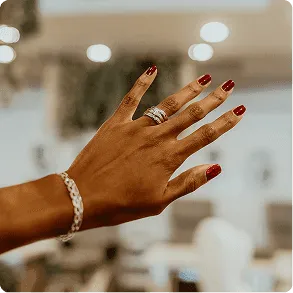
The short answer most people are looking for: a gel manicure usually lasts about two weeks, and often stretches closer to three before it genuinely needs attention. But that number moves more than almost any comparison chart admits, because how gel is applied matters as much as which product is used. At our Scottsdale salon, the sets that last the longest aren't the ones with the most expensive polish — they're the ones that were prepped, applied, and sealed without rushing. Here's a realistic timeline by service, and what actually decides where your own nails land on it.
How long each service really lasts
"Gel" gets used as a catch-all, so it helps to separate what's actually on your nails. These are typical ranges for a well-applied set on a natural nail growing at an average pace:
- Gel polish manicure — about 2 weeks. Glossy and chip-resistant, cured under an LED lamp. Many people comfortably reach the two-and-a-half to three week mark before the grown-out edge, rather than chipping, is what sends them back in.
- Dip powder — 2 to 3 weeks. A thicker, sturdier layer than standard gel polish, which is why it often holds a few days longer.
- Hard gel or builder gel overlay — up to about 3 weeks. A structured layer over your own nail adds durability, so an overlay tends to sit at the longer end of the range.
- Regular (air-dry) polish — a few days to a week. Traditional lacquer isn't built to last like gel. The exception is Dazzle Dry®, the non-toxic system we finish our manicures with, which can hold a glossy finish for up to two weeks without a UV lamp.
If you're weighing these against each other for reasons beyond longevity — finish, upkeep, or how each treats the natural nail — our gel vs. acrylic vs. dip guide covers that decision in full.
Why application quality changes the number
Two people can get the same gel polish and have completely different experiences: one set lasts eleven days before a corner lifts, the other goes three weeks looking untouched. The polish isn't the variable — the application is. A gel manicure only lasts as long as its seal holds, and that seal is built (or lost) in the steps you don't necessarily see:
- Prep. The natural nail has to be thoroughly cleaned, gently buffed, and dehydrated so the gel bonds to the plate instead of to residual oil. Skip this and even the best product lifts early.
- Thin, even coats. Gel applied too thick doesn't cure all the way through and is far more prone to peeling. Thin layers, fully cured, outlast one heavy layer every time.
- Capped edges. Sealing the free edge — running a thin line of gel along the very tip of the nail — is one of the biggest predictors of whether a set makes it two weeks or two days.
- Full cure. Each layer needs its full time under the lamp. An undercured set stays slightly soft and lifts sooner, even if it looks finished.
This is the real reason unhurried service isn't a luxury flourish — it's what makes the manicure last. When a technician takes the time to prep and cure properly, you're not paying for a slower appointment, you're paying for a set that survives to your next one.
The cuticle work nobody credits for longevity
Here's something most timelines leave out: how the cuticle area is handled affects how long a manicure looks fresh, not just how long it physically lasts. When polish stops short of the cuticle, even a millimeter, natural nail growth becomes obvious within days. When it sits flush against clean skin, the same growth is far less noticeable, so the set reads as "still fresh" a week or more longer. That's a large part of why a Russian manicure — the precise, dry cuticle technique we're known for in Scottsdale — is worth pairing with gel: it buys you visible days, not just structural ones.
What shortens the life of your gel nails
Once you leave the salon, a few everyday habits do most of the damage to an otherwise well-applied set:
- Water and heat without protection. Long hot showers, dishwashing without gloves, and frequent hand-washing all work at the seal over time.
- Using nails as tools. Opening cans, peeling stickers, and scratching are the fastest way to pop a corner loose.
- Picking or peeling. This is the one that actually harms the natural nail. When a gel edge lifts, peeling it off takes layers of your own nail with it — the thinning people blame on "gel" is almost always this.
- Skipping cuticle oil. A daily drop of oil keeps the nail and surrounding skin flexible, which helps the whole set stay put rather than growing brittle at the edges.
For a fuller routine on stretching any manicure as far as it will comfortably go, our guide on caring for natural nails covers the between-visit habits that matter most.
When to book your next appointment
Aim to rebook every two to three weeks, timed to your nail growth rather than to the first visible chip. Waiting much past that tends to leave a grown-out edge that's tempting to pick at, and picking is where the real damage happens. A gentle, on-schedule fill or removal protects your natural nail far more than trying to squeeze an extra week out of a tired set. If your gel routinely fails well before the two-week mark, that's worth raising with your technician — it usually points to a prep or curing step that can be fixed, not a limit of what gel can do.
Nails that go the distance, done gently
A gel manicure that lasts isn't luck, and it isn't the priciest polish on the shelf — it's careful prep, thin and fully cured layers, sealed edges, and clean cuticle work, none of which can be rushed. That's the standard every set gets at Pamprd Soul. Browse our manicure menu or explore all our services to find the finish that fits, and let a technician build you a set made to last through Scottsdale's busiest weeks.
Frequently Asked Questions
How long do gel nails last?
A gel polish manicure typically holds a glossy, chip-free finish for about two weeks, though many people get closer to three before it needs attention. Hard gel and builder gel overlays tend to last a little longer, up to about three weeks. The bigger variable is application quality: a properly prepped and sealed set consistently outlasts a rushed one, regardless of the product used.
Why do my gel nails only last a few days?
Gel that lifts or peels within days almost always points to prep or curing, not the polish. If the natural nail was not thoroughly cleaned and dehydrated, if the gel was applied too thick, or if the edges were not capped and fully cured, the seal fails early. A careful technician addressing each of those steps is usually the difference between a set that lasts days and one that lasts weeks.
When should you get gel nails filled or removed?
Most people book a new gel set or fill every two to three weeks, timed to their natural nail growth rather than to visible chips. Waiting much longer can leave a grown-out edge that tempts picking or peeling, which is what actually damages the natural nail. A gentle, properly done removal or fill on schedule protects the nail far more than stretching a set as long as possible.